DOSSIER
Smart Scales After 40: A Useful Trend Tool, or an Expensive Body-Fat Guess?
A smart scale is worth buying for one thing, just not the body-fat number. The Sterling readout on what to trust, what to ignore, and which to buy.
Bottom line
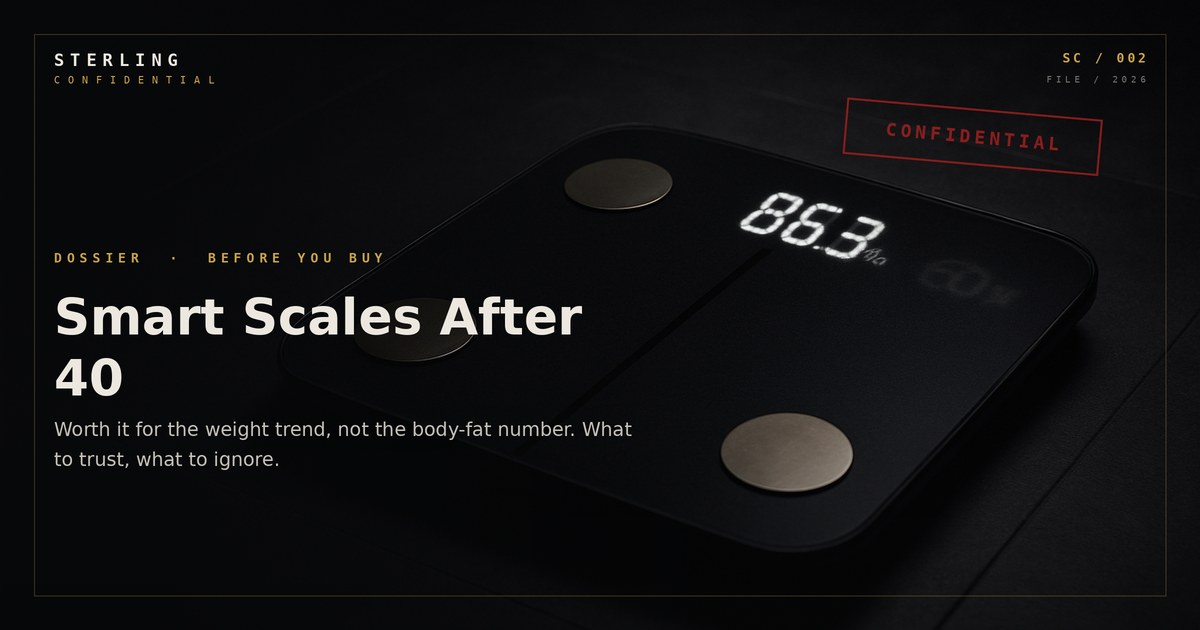
A smart scale is worth buying. But for one thing: the weight trend. The weight reading is reliable. The body-fat percentage it flashes is a rough estimate, not a measurement. It swings with how hydrated you are and when you last ate.
So buy a cheap-to-mid scale. Weigh under the same conditions a few times a week. Watch the trend line. Ignore the daily body-fat number. If you want a real body-composition figure, you need a DEXA scan, not a scale.
At a glance
| Weight trend | Body-fat percentage | |
|---|---|---|
| What it is | A real measurement | A rough impedance estimate |
| Trust it? | Yes, track the trend over time | No, ignore the daily number |
| Best use | Weigh under consistent conditions | Not a substitute for a DEXA scan |
| Worth paying for? | A cheap scale does it | Don’t pay up for body-fat features |
| Sterling verdict | The reason to buy a scale | A distraction, not data |
Who this is for
You’re over 40. You’re trying to lose the belly. You want to track your progress. And you’re standing in front of a shelf of scales that all promise body fat, muscle mass, and visceral fat.
The readout
A smart scale is two products in one box. As a bathroom scale, it’s accurate and useful. As a body-composition lab, it’s a guess with a nice app. Pay for the first. Don’t pay up for the second.
Important considerations
Weight is the reliable number. Smart-scale weight readings land within a few tenths of a kilogram of your true weight. That’s the number to track. For fat loss after 40, the weekly trend in your body weight tells you more than any single reading does.
Body fat is an estimate, not a measurement. These scales use bioelectrical impedance. They send a small current through your body and guess at your fat from how it flows. Consumer scales run roughly 3 to 8 percentage points off a DEXA scan. Several popular models have been shown to read fat mass a few kilograms lower than DEXA.
The number also moves with hydration, your last meal, a recent workout, even your foot temperature. Treat it as a mood ring with decimals.
The trend beats the number. Weigh under the same conditions every time. Ideally in the morning, after the bathroom, before eating or drinking, barefoot on a hard floor. Then read the line over weeks, not the figure on any one day. Day-to-day body-fat wiggles are just noise.
What does not matter much
The premium body-composition features. Multi-frequency and segmental scales estimate body fat a little better than basic foot-to-foot models. But none of them match DEXA. So paying extra for a “more accurate” body-fat number just buys you a slightly better guess.
Visceral fat scores, muscle-mass readouts, and “metabolic age” are the same estimate in a nicer font. Spend more only for a better app, or to sync with gear you already use.
Red flags
- A scale sold mainly on the precision of its body-fat or visceral-fat number.
- “Medical grade” or “DEXA accurate” body-composition claims.
- Treating daily body-fat changes as if they were real.
What to check first
Decide what you’re actually tracking. If it’s fat loss, the weekly weight trend and a tape measure around your waist do most of the job. You may not need the body-comp features at all.
Buyer filter
- What am I solving? Tracking fat-loss progress, not measuring body composition to the decimal.
- What number proves it? The weekly weight trend, backed by a waist measurement.
- Measuring or gadget? The weight is measuring. The body-fat readout is a gadget feature.
- Cheapest credible step? An inexpensive smart scale, or a basic scale plus a tape measure.
- What claim should make me suspicious? Any body-fat or visceral-fat accuracy claim.
- Who should skip? See below.
Best options and next steps
Any reliable scale tracks weight well. So buy on price and app fit, not on body-fat specs. Prices move around, so check the current price on Amazon rather than chasing a number here.
- Renpho Elis 1: the value pick, and the right call for most men. Reliable weight, a clean app, and a huge install base. The body-composition readouts are the usual impedance estimate, so use it for the weight trend. Check the current price on Amazon.
Maybe you already live inside a particular ecosystem. Then a pricier scale that syncs to it (Withings or Garmin, for example) can be worth it for the app, not for a better body-fat number. For everyone else, the value pick does the job.
Whichever you pick, weigh under the same conditions and read the trend, not the daily number. The scale tracks progress. It doesn’t diagnose anything.
Who should skip
If you already weigh yourself on a reliable scale and track your waist, a smart scale adds convenience, not accuracy. You can skip it.
And if daily weighing pulls you toward obsessive tracking, or you have a history of disordered eating, a smart scale is the wrong tool. Weigh weekly, or not at all, and measure progress another way. A number on a screen isn’t worth your peace of mind.
FAQ
Are the body-fat readings useless? Not useless, but unreliable as an absolute number. The trend in the reading, taken under consistent conditions, is more informative than the figure on any one day.
Should I buy a pricier scale for better body fat? No. Spend up only for a better app or ecosystem fit, not for a more accurate body-fat number.
How often should I weigh? A few mornings a week under the same conditions, and read the trend.
What gives a real body-fat number? A DEXA scan, not a consumer scale.
Sources
- BodySpec. How Accurate Are Smart Scales?; and Best Smart Scale Buying Guide (2026).
- BodySpec, citing JMIR mHealth and uHealth (2021) on fat-mass underestimation versus DEXA.
- Hume Health. Smart Scale Accuracy: How BIA, DEXA, and the Body Pod Compare.
- Live Science, Reviewed, and Tom’s Guide. Best smart scales of 2026.
Medical disclaimer: Sterling Confidential publishes educational buyer-intelligence content only. It does not provide medical advice, diagnosis, or treatment. Readers should talk to a qualified clinician before making medical decisions, changing medication, interpreting labs, starting supplements, or treating a health condition.
Affiliate disclosure: Some links may earn Sterling Confidential a commission. Compensation does not guarantee inclusion or positive coverage. The goal is to help readers make cleaner decisions, not push products they do not need.