DOSSIER
Upper-Arm vs. Wrist Blood-Pressure Monitors: Which Should You Buy for Home Tracking?
The accuracy of a home blood-pressure monitor comes down to three things, and monitor type is only one of them. The Sterling readout on what to buy and what to ignore.
Bottom line
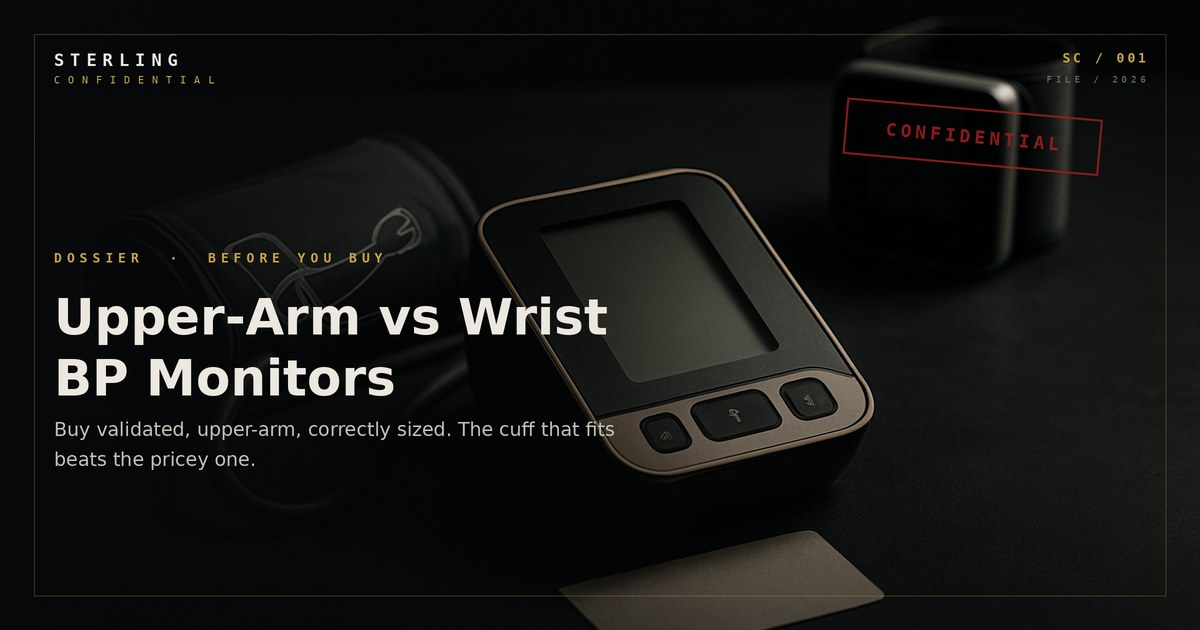
Buy a validated, automatic, upper-arm cuff monitor in the right cuff size. Skip wrist monitors. The only exception is if your upper arm is too large for a cuff, or measuring it hurts. In that case, use a validated wrist model held at heart level.
The expensive mistake isn’t picking the wrong type of monitor. It’s buying a device that was never independently validated, or running the wrong cuff size. The wrong size alone can move a reading enough to push you from one blood-pressure category into another.
At a glance
| Upper-arm cuff | Wrist monitor | |
|---|---|---|
| Accuracy | Most reliable; the clinical standard | More position-sensitive and error-prone |
| Who it’s for | Almost everyone | Only if the arm is too large for any cuff |
| Biggest mistake | Wrong cuff size or unvalidated model | Cuff not held at heart level |
| What to check | Validated on validatebp.org | Fewer validated models exist |
| Sterling verdict | Buy this | Skip unless a cuff won’t fit |
Who this is for
You’re a man over 40. You got a high reading, or a “watch this” from your doctor. Now you’re standing in front of a wall of monitors. Cheap wrist units sit next to bigger arm cuffs, and you’re not sure which to grab.
The readout
Most of the price and features on that shelf won’t change whether the number is right. Three things do. The device is independently validated. It’s an upper-arm cuff. And the cuff fits your arm.
Get those three right, and a mid-priced monitor will track you well. Miss them, and a pricey one will give you the wrong number.
Important considerations
Independent validation. Look for the monitor on the US Blood Pressure Validated Device Listing at validatebp.org. The American Medical Association maintains this list through an independent committee of physician reviewers. Validation means the device was tested for accuracy against a clinical standard. Many monitors sold online never went through it.
Upper-arm cuff, not wrist. Current American Heart Association guidance recommends an automatic, cuff-style, upper-arm monitor. It advises against wrist and finger monitors for routine home use. Wrist readings tend to run higher. They’re also far more sensitive to position, because the height of your wrist relative to your heart changes the reading.
Correct cuff size. This is the one most men miss. In a randomized trial published in JAMA Internal Medicine, using a regular-size cuff on someone who actually needed an extra-large one overstated systolic pressure by about 19.5 mmHg on average. Too-large cuffs read low. Too-small read high. Measure your upper-arm circumference and match the cuff range before you buy.
What does not matter as much
Apps, color screens, and cloud dashboards are fine for logging. They do nothing for accuracy. A rock-bottom price on an unvalidated unit saves you nothing if the number is wrong.
Smartwatch or cuffless blood-pressure features aren’t a substitute either. The AHA’s scientific statement says cuffless wearable BP isn’t yet validated for diagnosing or managing high blood pressure. Treat it as a curiosity, not a real measurement.
Red flags
- “Clinically accurate” or “doctor recommended” with no validation listing you can actually check.
- A wrist monitor marketed as the default choice because it is convenient.
- One cuff sold as fitting everyone, with no size guidance.
- A smartwatch sold as a replacement for a real monitor.
What to check first
Before you buy anything, do two things. First, measure your upper-arm circumference with a tape so you know which cuff size you need. Then open validatebp.org and confirm the exact model is on the list. A trusted brand name isn’t enough on its own. Validation is by model.
Buyer filter
- What am I actually solving? Reliable home readings, not a diagnosis.
- What number proves the setup is right? Your upper-arm circumference, matched to the cuff, on a validated device.
- Is this device measuring, or is it a gadget? A watch or a wrist unit chosen for convenience leans gadget.
- What is the cheapest credible step? A validated, correctly sized upper-arm monitor in the mid-price range.
- What claim should make me suspicious? Any accuracy claim with no validation listing behind it.
- Who should skip? See below.
Best options and next steps
Pick a validated upper-arm monitor in your cuff size. Brands on the AMA validated list include Omron, A&D Medical, and Microlife, among others. Confirm the specific model on validatebp.org rather than trusting the brand alone.
Here’s a solid default that meets all three tests:
- Omron Platinum Upper Arm Monitor: a clinically validated upper-arm cuff from the most-recommended home brand. It has a wide-range cuff that fits most adult arms, stored readings, and an irregular-heartbeat indicator. Confirm the exact model you buy on validatebp.org, and check the current price on Amazon.
If your arm is at the larger end, A&D Medical also makes validated upper-arm monitors with a true large cuff. That’s where one-size units fall apart. Again, confirm the specific model on validatebp.org. The brand matters less than three things: validated, upper-arm, and a cuff that fits.
Whatever you pick, confirm the exact model on validatebp.org. And if your arm sits near the top of a cuff’s range, size up.
Then use it correctly, because technique moves the number as much as the hardware does. Sit with your back supported and your feet flat. Rest your arm so the cuff is at heart level. Sit still for about five minutes before you start. Take two or three readings a minute apart and write them down. Bring that log to your clinician. The monitor measures. It doesn’t diagnose, and it doesn’t treat.
Who should skip
If your upper arm is too large for available cuffs, or measuring it hurts, the upper-arm cuff isn’t your device. In that case, a validated wrist monitor held at heart level is the acceptable fallback.
One more thing. Stop shopping and call a clinician now if you have very high readings. Do the same for symptoms like chest pain, shortness of breath, or a severe headache, or for readings that stay high over several days. A home monitor is for tracking. It’s not a tool for deciding on your own whether to start, stop, or change medication.
FAQ
Are wrist monitors ever accurate? They can be, especially validated models held carefully at heart level. They are also easier to use wrong, which is why they are not the default.
Is a more expensive monitor more accurate? Not necessarily. Validation and cuff fit do more for accuracy than price does.
Can my smartwatch replace a monitor? Not for managing blood pressure. Cuffless and wearable BP features are not validated for that yet.
How often should I measure? Follow your clinician’s guidance. Many home protocols use a few mornings and evenings in a row rather than a single reading.
Sources
- American Heart Association. Monitoring Your Blood Pressure at Home. heart.org.
- Mayo Clinic. Wrist blood pressure monitors: Are they accurate?; and American Heart Association (Hypertension). Poor Reliability of Wrist Blood Pressure Self-Measurement at Home.
- US Blood Pressure Validated Device Listing. validatebp.org (American Medical Association / NORC).
- Ishigami J, et al. Effects of Cuff Size on the Accuracy of Blood Pressure Readings: The Cuff(SZ) Randomized Crossover Trial. JAMA Internal Medicine, 2023.
- Cleveland Clinic. Do Wrist Blood Pressure Monitors Work?
- American Heart Association. Cuffless Devices for the Measurement of Blood Pressure: A Scientific Statement.
Medical disclaimer: Sterling Confidential publishes educational buyer-intelligence content only. It does not provide medical advice, diagnosis, or treatment. Readers should talk to a qualified clinician before making medical decisions, changing medication, interpreting labs, starting supplements, or treating a health condition.
Affiliate disclosure: Some links may earn Sterling Confidential a commission. Compensation does not guarantee inclusion or positive coverage. The goal is to help readers make cleaner decisions, not push products they do not need.